When the Law is Silent, Society Is Complicit in Femicide!
By Astan Keita & Sarah Toure
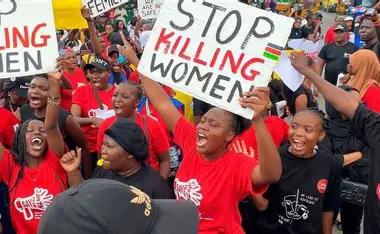
Femicide, a term that has shockingly appeared in most Cameroonian vocabulary. But why? Because deaths of women and girls are no longer isolated incidents but part of a broader and deeply concerning pattern. As we painfully remember Ngah Cecile, Alida Marceline, Orphee Bissolo, Fortune Fongwi, Mispoa Noumi, Rahilou, Mani Teclaire, Diane Yangwo, and over 76 more femicide cases of young women who died, were assaulted and killed by their husbands, partners, ex-partners and boy-friends, between 2023 and 2025 (WCO, 2025, p.42).
Over the past decade, Cameroon has witnessed a rapid increase in women’s abuses from Gender-based violence to femicide. Culture and norms have transformed physical violence into something acceptable and justifiable. The patriarchal nature of the society, placing men’s privileges and rights above those of women, has left many children orphaned and families fractured.


However, the social normativity of these privileges only fuels violence against women, even though sanctioned by law, it is not strongly sanctioned by cultures and norms which tend to prevail in Cameroon. The Afrobarometer round 9 (2021/2023) survey indicates that 44% of people considered domestic violence a private matter, and 54% considered it a criminal matter (Afrobarometer 2024). The perception of domestic violence is therefore mixed between the fight for human rights and societal expectations. When disaggregated by gender, 26.1% of men consider domestic violence to be a private matter, while 28.5% view it as a criminal issue. Among women, 20.4% perceive domestic violence as a private matter, whereas 39.8% consider it a criminal matter.
Observing the patterns of this perception by education level (see fig.1) does not reveal large structural differences in how men and women perceive domestic violence. However, a notable convergence can be observed among men and women with post-secondary education (PSE), who express similar views regarding domestic violence as a criminal matter, although the proportion remains higher among women. These patterns suggest that perceptions of domestic violence are influenced not only by educational attainment but also by broader social dynamics. In particular, increasing attention has been drawn to the often underreported experiences of domestic violence against men, indicating that such cases may be more widespread than commonly assumed rather than isolated incidents.
Figure 1: Perception of Domestic violence against women by level of education in Cameroon

Although Cameroon has adopted several international legal instruments aimed at protecting women’s rights, including the Convention on the Elimination of All Forms of Discrimination against Women, ratified on 23 January 1994, its Optional Protocol, ratified on 7 July 2005, and the Protocol to the African Charter on Human and Peoples’ Rights on the Rights of Women in Africa, ratified on 29 May 2009, the monitoring and enforcement mechanisms attached to these instruments remain relatively limited in practice.
A clear illustration of this limitation can be observed in the periodic review process under CEDAW. Cameroon was last formally reviewed by the Committee on the Elimination of Discrimination against Women in 2014, when the Committee considered the country’s combined fourth and fifth periodic reports. The next stage in the reporting cycle only emerged with the publication of a List of Issues in 2026.
This twelve-year gap between review cycles (2014–2026) highlights a broader structural challenge in the enforcement and monitoring of gender equality commitments. It reflects not only delays in international accountability mechanisms but also deeper systemic weaknesses in the implementation and oversight of gender-related legal frameworks at both the national and international levels, leading to the challenging assessment of significant changes in women’s and girls’ inequality, discrimination and violence.
While reporting cases of violence to the police can trigger important interventions, such as judicial support, it is often insufficient to significantly reduce the incidence of violence or to adequately protect victims, particularly women and girls. Moreover, reliance on police reporting alone does not function effectively as either a preventive or a curative mechanism in addressing gender-based violence.
From the law enforcement and policy protection perspectives, there is less to say, given the systemic fragility of institutions, about either acting against GVB or effectively preventing it, despite the National Strategy for the Fight Against Gender-Based Violence (2022-2026). Enshrined in sociocultural thinking, the 2023 Central Bureau of Census and Population Studies (BUCREP) reports, that over 15% of women believe that domestic violence is justifiable for various reasons related to insubordination and disrespect against their spouse, 10% believe domestic violence is justifiable when women refuse to have sex with their partners, and 8% when they burn food (BUCREP, 2024, p.19). Such pernicious beliefs further undermine policy efforts, crippling progress toward the elimination of gender-based violence. Furthermore, when talking about GBV, its definition, scope and domain of intervention remain vague in Cameroon, leaving room for multiple interpretations and limited targeted law enforcement and measures, a situation highlighted by the CEDAW committee List of issues 2026 to be addressed by the State:
“(a) Adopting a comprehensive definition of discrimination against women that covers direct and indirect discrimination, including intersecting forms of discrimination, in both the public and private spheres, in accordance with articles 1 and 2 of the Convention;”(CEDAW, 2026, p.2).
This situation also highlights the challenges associated with systematic data collection, which hinder efforts to accurately assess the true scale of violence against women and girls. The lack of comprehensive and reliable data further limits the effectiveness and reach of policy interventions, a concern highlighted in the 2026 CEDAW List of Issues addressed to Cameroon:
“(e)To collect disaggregated data on the number of cases of gender-based violence against women reported, investigated, prosecuted and convicted since the consideration of the previous periodic reports, the sentences imposed, and the number of protection orders issued and women who have received support services;” (CEDAW, 2026, p.5).
This weak systemic management also contributes to the rise of femicide, which is often subsumed within the system as cases of “ordinary” marital or relationship violence. As a result, the specific nature and severity of femicide frequently remain obscured. The report produced by the Women and Children Organisation in Cameroon(WCO), typically mapping femicide landscape, shows an increase of over 53.4% of femicide cases between 2023 and 2025 (WCO, 2025,42), principally women and girls between 16 and 35 years old, irrespective of socio-professional status. The rising concern of this phenomenon, although shocking to public opinion, is rapidly overshadowed by sociocultural explanations of such acts, justified in ways of living as mentioned by BUCREP and further emphasised by WCO. Violence is often tolerated, normalised, and even implicitly endorsed by family networks, communities, and, at times, state institutions. In the absence of a systematic framework that integrates preventive, punitive, and curative mechanisms, societies remain limited in their capacity to understand the different forms of violence, recognise early warning signs, and challenge deeply embedded cultural norms that perpetuate harmful gender expectations. As a result, women and girls continue to face inadequate protection from discrimination, violence, and femicide.
These shortcomings underpin the recommendations put forward by the Women and Children Organisation in Cameroon (WCO, 2025, p. 59), as well as the concerns highlighted in the CEDAW List of Issues addressed to Cameroon:
“(a)To adopt a comprehensive law on violence against women; to criminalize domestic violence, including marital rape, sexual harassment in the workplace and educational institutions, and technology-facilitated violence; to repeal the legal provision that exempts rapists from punishment if they subsequently; And
(f) To establish a national observatory to systematically monitor, document and analyse cases of femicide, and to use such data to inform prevention and response strategies. (Cedaw, 2026, p.5).
As we conclude, we stand firmly on the belief in social reform, in which State intervention will not only be limited to public statements or to the arrest of perpetrators (when possible), but also to actions that are intentional, structural, and meaningful. Femicides and GBV in Cameroon are not related to education nor to social status; all women and girls are exposed, hence actions should be familial, local, and national. These sample cases, mentioned at the beginning of this blog, sufficiently show that femicides are real and actions are needed. Actions are critically needed, considering the number of undocumented femicides cases happening in the North and South West regions of Cameroon due to conflict, considering the violence women and girls are facing, such as conflict rape, forced mariages and forced prostitution (direct and indirect), women and children who are dying during childlabour due to lack of proper medical equiqment and qualify human resources. The Anglophone crisis, considered a forgotten conflict internationally, is therefore a strong multiplier of GBV and femicides against women, girls and children.
As we recall the cases of over 76 femicides, most of them documented via social media channels, online blogs, BUCREP and the Institut of National Statistic (INS), are concentrated in the non-conflict areas, especially Yaounde and Douala, having the highest femicide rates (WCO, 2025,45). However, this raises a critical concern: what about the women, girls, and children whose deaths remain undocumented or silenced in conflict-affected regions? In areas such as the North-West and South-West regions affected by the Anglophone conflict, the Far North region facing Boko Haram insurgency, and the East region impacted by the Central African refugee crisis, violence against women often occurs in conditions where systematic documentation and reporting mechanisms are weak or absent. As a result, many cases of gender-based violence and femicide remain erased from official statistics and public memory.
Against this backdrop, establishing a systematic and regionally structured data collection mechanism on femicides in Cameroon is essential. A coordinated system that collects and analyses data across all regions would enable authorities, stakeholders and civil society organisations to better prevent, respond to, and address femicide. Data collection will ensure that measures at different levels are accurate and responsive, and will provide a clear determination to end and considerably reduce GBV and femicides and act before she dies.
#actB4shedies.